Practice Paper – TERM II (2021 – 2022)
Class – IX
Science (086)
Time: 2 hours Maximum Marks: 40
General Instructions:
i) All questions are compulsory.
ii) The question paper has three sections and 15 questions. All questions are compulsory.
iii) Section–A has 7 questions of 2 marks each;
iv) Section–B has 6 questions of 3 marks each; and
v) Section–C has 2 case based questions of 4 marks each.
vi) Internal choices have been provided in some questions. A student has to attempt only one of the alternatives in such questions.
SECTION – A
1. A group of students with their team leader visited the school campus and its surroundings to check the stagnant water. The students saw many such points with mosquitoes breeding in it.
(a) Name the mosquito that causes malaria.
Female anopheles’ mosquito
(b) Name one more disease that can be caused by mosquito bite.
Dengue
2. Define the following:
(a) immunity
The body’s power to resist and overcome an infection/disease
(b) immunization
A specific method of preventing diseases by inoculating vaccines inhuman body.
3. (a) If Z = 7, what would be the valency of the element?
3
(b) Name the element.
Nitrogen
4. (a) What is acceleration due to gravity?
The force with which any body gets attracted towards the earth surface.
(b) Show relation between g & G
g = G x M/r2
OR
Calculate the value for g (Mass of the earth = 6 x 1024 kg & radius of the earth = 6.4 x 10⁶ m.)
By using above formula, we get g = 9.8 m/s2
5. (i) What is potential energy of a body?
The energy possessed by a body due to its position
(ii) An object of mass 40kg is raised to a height of 7 m above the ground. What is its potential energy?
P.E = m x g x h = 2800 J
6. A doctor/nurse/health-worker is exposed to more sick people than others in the community. Suggest two ways, how he/she avoids getting sick himself/herself.
i. By taking care of preventative measures like personal and community hygiene/ cleanliness
ii. Immunization
OR
How are acute diseases different from chronic diseases?
Acute diseases remain for short duration while chronic diseases remain for a long duration of time.
7. Classify the following diseases as communicable or non-communicable:
i. Dengue – Communicable
ii. Cancer – Non-communicable
iii. AIDS – Communicable
iv. Low blood pressure – Non communicable
SECTION B
8. Write any three postulates of Dalton’s atomic theory.
i. All matter is made of very tiny particles called atom.
ii. Atom is indivisible and indestructible.
iii. Atoms of the same element will have same mass and chemical properties
OR
(i) What do you mean by electronic configuration of an atom?
The distribution of electrons in various shells of an atom
(ii) Write the electronic configuration for Aluminium and Neon atom.
Al – 2, 8, 3 & Ne – 2, 8
9. (a) Define 1 watt of power.
When 1 Joule of work is done in 1 second.
(b) Show relation between power and electric energy.
P = E/t
(c) A lamp consumes 1000 joules of electric energy in 10 seconds. What is the power?
100 W
10. (a) Show one point of difference between isotopes and isobars.
Isotopes are the atoms of the same element with same atomic number but different mass numbers whereas isobars are the atoms of different elements having same mass numbers but different atomic numbers.
(b) Write any two applications/uses of isotopes.
Any two uses
11. In a gold foil experiment –
(a) Why did many alpha particles pass through the gold foil undeflected?
Most of the space inside the atom is empty.
(b) Why did few alpha particles deflect through small angles?
Positive charge of the atom occupies very little space.
(c) Why did few alpha particles, after striking the gold foil, retrace their path?
Nucleus of the atom is very small as compared to the total size of the atom.
OR
The average atomic mass of a sample of an element X is 16.2 u. What are the percentage of isotopes 8X16 and 8X18 in the sample?
Let the percentage of 8X16 be A%. Then the percentage of 8X18 be (100 – A)%
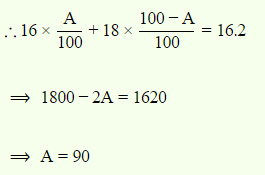
So the answer is 90% 8X16 10% 8X18
12. (a) Define kinetic energy of a body.
The energy of a body due to its motion.
(b) Derive the expression for kinetic energy.
W = F x S …..(1)
F = m x a
Using v2 – u2 = 2aS to get S
By substituting above values in eq (1), we get the required exprssion
13. Draw the sketch/shell diagram of Bohr’s model of the atom for Nitrogen, Fluorine and Sulphur atoms.
SECTION C
This section has 2 case-study based questions (14 & 15). Each case is followed by three sub-questions (a, b & c). Part a & b are compulsory. However, an internal choice is provided in section C.
14. Read the following passage and answer the questions given below:
According to Universal law of gravitation, the force of gravitation between two particles/bodies is directly proportional to product of their masses and is inversely proportional to the square of the distance between them. G is a universal constant as it value remains the same throughout the universe whereas g is gravity and it is the force with which anybody gets attracted towards the surface of the earth and its value changes from place to place.
(a) What is the value of G?
6.67 x 10⁻¹¹
(b) What do you mean by free fall?
When any body falls towards the earth under the influence of gravity.
(c) Why is the weight of an object on the moon is 1/6 its weight on the earth?
It is because the value of acceleration on moon is 1/6 of the value of acceleration on earth.
OR
The earth and the moon are attracted to each other by gravitational force. Does the earth attract the moon with a force that is greater or smaller or the same as the force with which the moon attracts the earth? Why?
According to Universal law of gravitation, two objects attract each other with equal force but in opposite direction.
The earth and the moon are attracted to each other by same gravitational force because for both of them, the formula to calculate force of attraction is the same.
F = G Me x Mm/d2
15. An atom is the smallest particle of matter. There are three sub-atomic particles of an atom i.e., electrons, protons and neutrons. The number of electrons gives the idea of the atomic number of an atom. The tendency to gain or lose electrons decides the charge of an atom.
(a) What is the charge present on an oxygen atom? Name the type of ion also.
Negative, Anion
(b) Derive the chemical formula for magnesium chloride and sodium oxide.
MgCl2 & Na2O
(c) (i) What is atomicity?
The number of atoms present in one molecule of a substance.
(ii) How many atoms are present in HCl and HSO4 ion?
2 & 6 atoms.
OR
What makes an atom electrically neutral?
When the magnitude of electrons is equal to magnitude of protons.